Life jackets
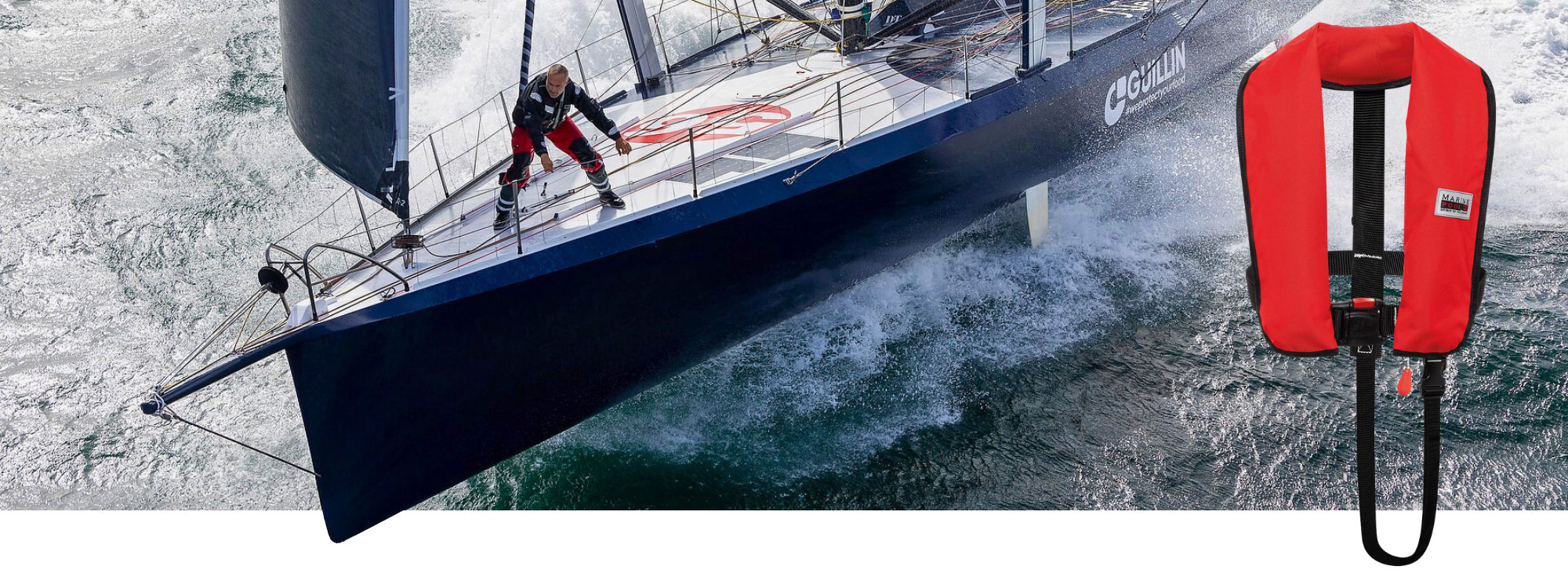
Life jackets from 100 Newton (N) provide reliable safety on the water – whether for non-swimmers in sheltered waters or for water sports enthusiasts in demanding conditions. Depending on the buoyancy class – 100 N, 150 N, or 300 N – these vests are suitable for different areas of use, ranging from inland waters to offshore and open sea. All models are designed to quickly turn the wearer into a stable back position and keep the head above water – even in the event of unconsciousness. Thanks to certified safety standards (ISO 12402-2 to -7) and a collar that ensures buoyancy even when unconscious, they allow for free breathing and maximum reliability.
OUR HIGHLIGHTS | inflatable LIFE JACKETS
-
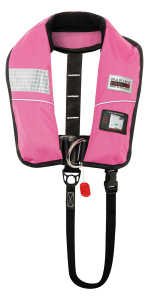 150N Premium Junior ISO UML Pro SensorSpecial Price €76.90 Regular Price €119.90Incl. VAT, excl. shipping cost
 -
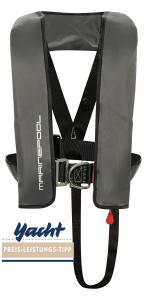 180N Racer ISO Lifejacket LB UMLSpecial Price €79.90 Regular Price €119.90Incl. VAT, excl. shipping cost
 -
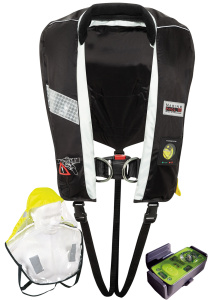 300N Pro 3D ISO Lifejacket MA1 + Sprayhood & lightSpecial Price €249.90 Regular Price €269.90Incl. VAT, excl. shipping cost
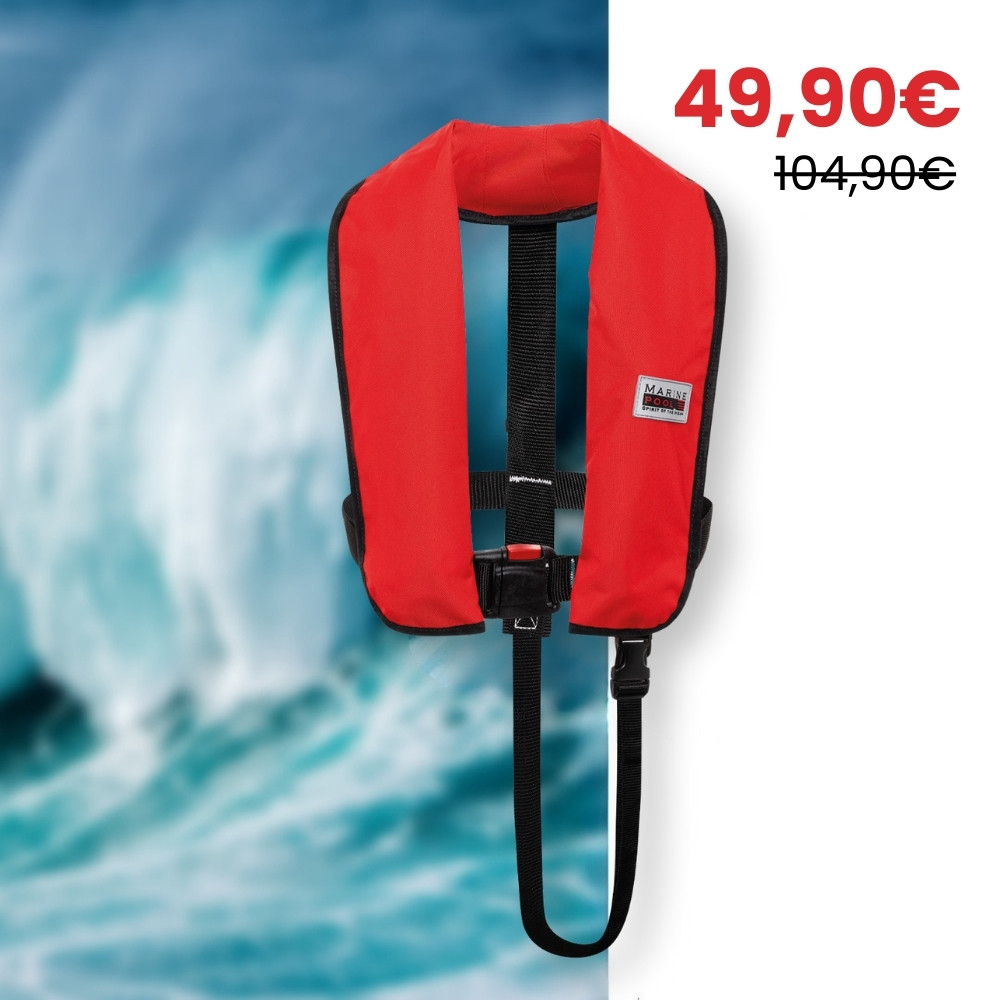
In the field of inflatable life jackets, a distinction is made between semi-automatic and fully automatic models. With a semi-automatic life jacket, the wearer must intervene manually to inflate the jacket – usually by pulling a ripcord that activates the CO₂ cartridge and inflates the air bladder. A fully automatic life jacket, on the other hand, inflates automatically as soon as it comes into contact with water. This is made possible by a triggering mechanism that reacts to water.
OUR HIGHLIGHTS | FOAM LIFE JACKETS
-
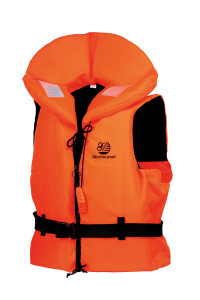 100N Freedom ISO PE-60/70kgSpecial Price €29.90 Regular Price €38.90Incl. VAT, excl. shipping cost
The core of every 100N life jacket is the integrated foam buoyancy element. This design makes the jacket ready for immediate use, as it does not need to be inflated. The inner lining ensures high wearing comfort, even during extended use directly on the skin. The arrangement of the buoyancy panels quickly turns the wearer into a safe back position. The collar, designed for unconscious situations, keeps the head above water and allows for unrestricted breathing.
OUR HIGHLIGHTS | CHILDREN’S LIFE JACKETS
-
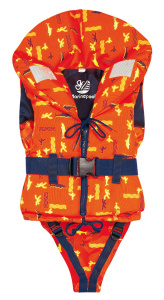 100N Freedom Fish Design ISO-5/10kgSpecial Price €34.90 Regular Price €44.90Incl. VAT, excl. shipping cost
 -
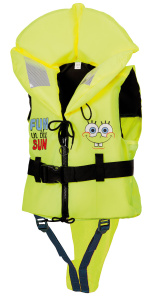 100N Freedom Sponge Bob ISO-10/15kgSpecial Price €34.90 Regular Price €44.90Incl. VAT, excl. shipping cost
 -
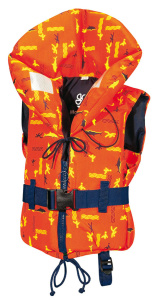 100N Freedom Fish Design ISO-20/30kgSpecial Price €29.90 Regular Price €41.90Incl. VAT, excl. shipping cost
 -
150N Premium Junior ISO UML Pro SensorSpecial Price €76.90 Regular Price €119.90Incl. VAT, excl. shipping cost
The perfect companion for babies and children. The collar designed for unconscious situations is especially important for the little ones, as it ensures that the child always floats face-up and can breathe.
for Rescue services
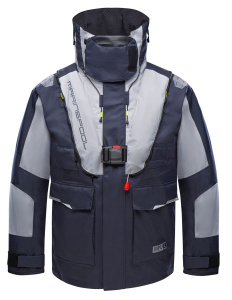
ALLE ENTDECKEN!
Life Jackets
Life jackets provide reliable safety on the water whenever buoyancy alone is not enough. Marinepool life jackets and life vests are designed for sailing, motorboating, fishing, leisure use, children and demanding offshore conditions – from 100N foam life jackets to inflatable life jackets with 150N, 180N, 220N or 300N buoyancy.
Marinepool Life Jackets
A life jacket is essential safety equipment for situations in which a person in the water may no longer be able to actively support their own safety. Unlike a buoyancy aid, a life jacket is not only designed to provide additional flotation. Its main purpose is to help bring the wearer into a safer floating position and keep the head and airways above water.
Marinepool life jackets are developed for a wide range of applications: sheltered inland waters, coastal sailing, motorboats, fishing, leisure boating, offshore passages and children’s life jackets. Depending on the model, they use either integrated foam buoyancy or inflatable systems with a CO₂ cylinder. This affects volume, freedom of movement, comfort, buoyancy class, activation system, equipment features and maintenance requirements.
Choosing the right buoyancy class is particularly important. 100N foam life jackets are often used for sheltered waters, leisure boating, guests on board, non-swimmers and children. They are always active, robust and easy to use. 150N inflatable life jackets are a common choice for sailing, motorboating and coastal waters. Inflatable life jackets with 150N, 180N, 220N or higher buoyancy combine reliable safety with excellent freedom of movement on deck. 300N inflatable life jackets are designed for demanding conditions, offshore sailing, heavy weather and use over technical sailing jackets or full sailing gear.
The right life jacket depends on several factors: sailing area, weather, water temperature, swimming ability, clothing, body weight, activity and personal safety requirements. For children, correct weight range, fit, collar shape and secure adjustment are especially important. For adults, the key decision is often whether a compact inflatable life jacket or a robust foam life jacket is the better match for the intended use.
Depending on the activity, life jackets should be part of a complete safety setup. For sailing, they combine well with a sailing jacket, sailing trousers or salopettes, sailing shoes and, where required, a lifeline. For longer passages, regattas or offshore sailing, rescue accessories, rearming kits, sprayhoods, lights and waterproof bags can also be relevant.
Life Jacket or Buoyancy Aid – What Is the Difference?
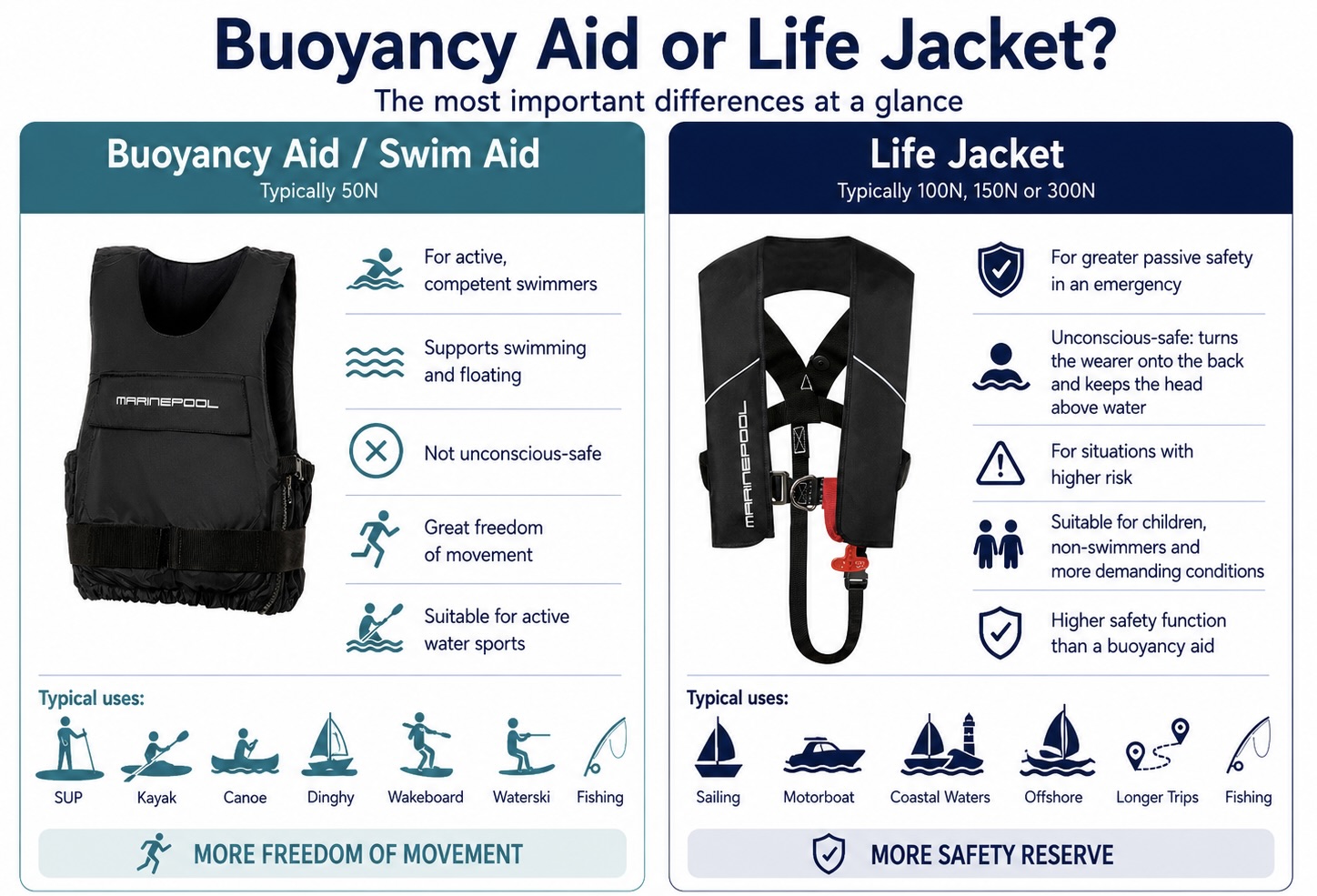
The most important difference between a life jacket and a buoyancy aid is the level of safety provided in critical situations. A life jacket is designed to help turn the wearer into a safer floating position and keep the head and airways above water. This is especially important if a person is unconscious, exhausted, injured, cold or not a confident swimmer.
A buoyancy aid, on the other hand, is usually a 50N flotation aid. It supports active watersports users while swimming or floating but is not intended for unconscious situations. A buoyancy aid assumes that the wearer can swim, is conscious and can actively help themselves in the water.
For dinghy sailing, SUP, kayaking, canoeing, wakeboarding or other active watersports in sheltered waters, a buoyancy aid may be the right choice because it offers a high level of mobility. Whenever passive safety is required, a life jacket is the safer option. This applies in particular to non-swimmers, children, cold water, longer trips, rougher conditions, offshore sailing or situations in which the wearer may not be able to react actively.
Which Life Jacket Is Right for Your Activity?
| Area of use | Conditions | Recommended category | Product suggestions |
What Do 100N, 150N and 300N Mean?
The Newton value describes the buoyancy class of a life jacket. It helps to identify the intended safety level and area of use.
In practice, this means:
- 100N life jackets are mainly used for sheltered waters, leisure boating, children and non-swimmers. Many models are foam life jackets and are ready for immediate use.
- 150N life jackets are a common choice for sailing, motorboating and coastal waters. They offer more buoyancy and are often used as inflatable life jackets.
- 180N and 220N life jackets provide additional buoyancy reserves depending on the model and can be suitable for more demanding use.
- 300N life jackets are designed for offshore sailing, heavy weather, professional use and use over substantial sailing clothing.
More buoyancy does not automatically mean that every life jacket is better for every situation. A 300N life jacket can be the right choice for offshore passages, while a correctly fitting children’s life jacket may be more suitable for a child on sheltered waters. The right decision always depends on the user, the clothing, the waters and the activity.
What Should You Consider When Buying a Life Jacket?
Before buying a life jacket, the intended use should be clear. Is it for children on board, guests, regular sailing, coastal cruising, offshore passages, fishing or motorboating? Once this is defined, buoyancy class, construction, fit and equipment features can be selected more precisely.
Pay attention to the right buoyancy class, correct weight range, secure fit and suitable construction. A foam life jacket is always active and easy to use. An inflatable life jacket offers more freedom of movement but requires regular checks and maintenance. If the life jacket is worn over oilskins, a thick sailing jacket or several layers, the fit must be checked with this clothing.
Important features may include crotch strap, collar, reflective details, whistle, lifebelt, sprayhood, light and suitable rearming kits. A life jacket must work when it matters most, so it should not be selected by price or appearance alone, but by safety requirements, comfort and the actual conditions on the water.
How Should a Life Jacket Fit?
A life jacket should sit close to the body without restricting breathing or necessary movement. Close all buckles and adjust the straps so that the jacket remains stable. If the life jacket is pulled upward at the shoulders, it should not slide over the chin or head.
Adults should check the fit over the clothing they will actually wear on the water. An inflatable life jacket must sit correctly over a sailing jacket, midlayer or foul weather gear. For children, fit is even more critical. A children’s life jacket that is too large is not a safety advantage; it can move out of position in the water.
Care, Checks and Maintenance of Life Jackets
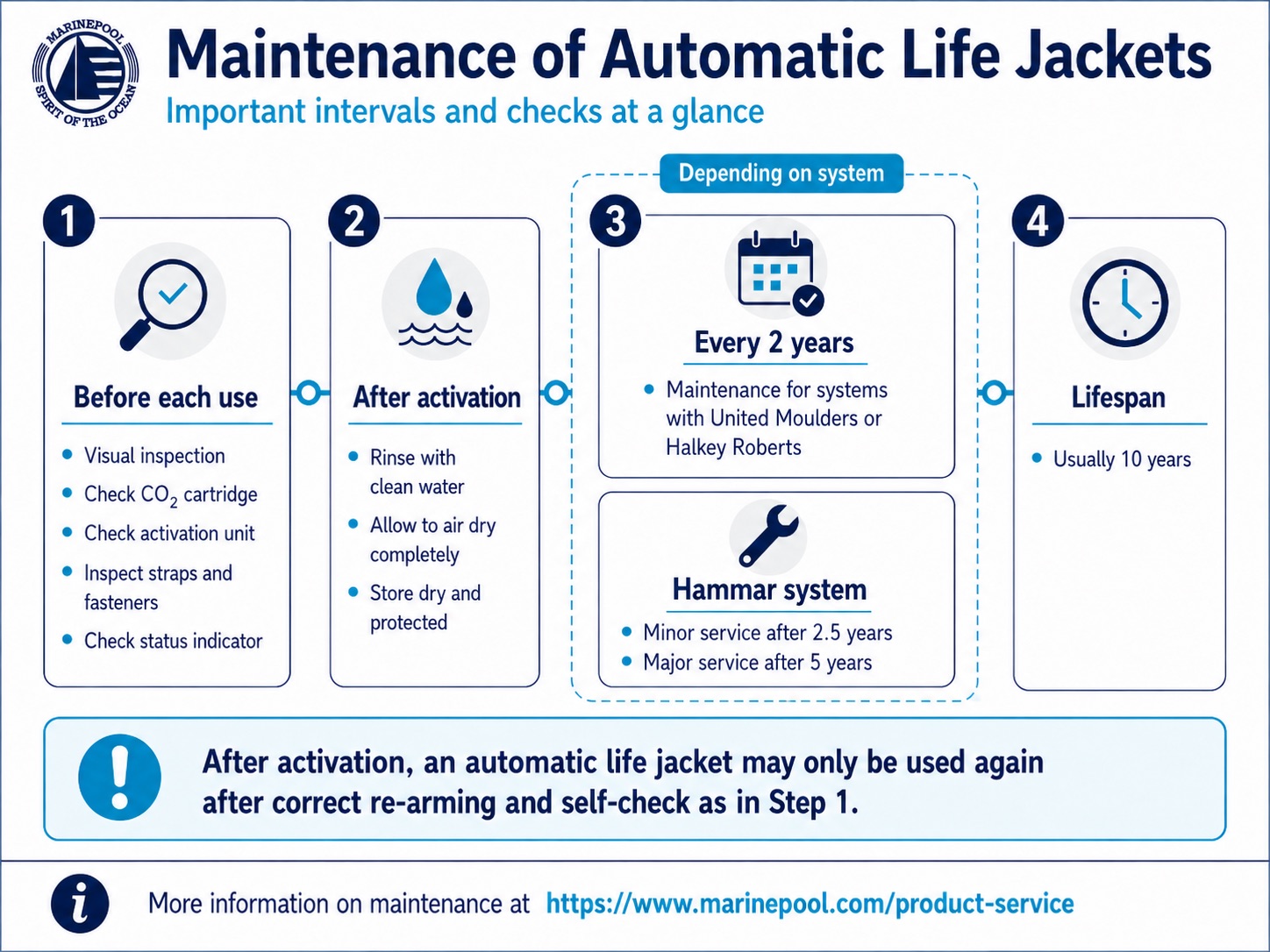
Life jackets should be checked after use and rinsed with fresh water if they have been exposed to salt water or dirt. They should then dry completely in the air before storage. Direct heat, tumble drying, radiators and long periods of intense sunlight should be avoided. General care information is available under product care.
For foam life jackets, seams, straps, buckles, collar and foam buoyancy panels should be checked regularly. If the foam is damaged, heavily compressed or deformed, the life jacket should no longer be used.
For inflatable life jackets, additional checks are necessary: CO₂ cylinder, inflator system, status indicator, oral inflation valve, outer cover and accessories such as sprayhood or light must be inspected. Life jackets with United Moulders or Halkey Roberts systems should be serviced every 2 years. Hammar systems require small maintenance after 2.5 years and major maintenance after 5 years. The service life of an inflatable life jacket is generally 10 years. After professional inspection, further use may be assessed individually. More information is available under product service and maintenance.
After activation, an inflatable life jacket must not be used again until it has been correctly rearmed and checked. Suitable spare parts are available under rearming kits. For additional safety equipment and upgrades, see rescue accessories.
More Than 35 Years of Experience on the Water
Since 1991, Marinepool has been developing equipment for people who want to move safely on and around the water. Our roots are in sailing, but our experience reaches far beyond it: cruising, regatta sailing, motorboating, fishing, leisure activities, professional use and offshore conditions.
This experience is especially important when it comes to life jackets. A life jacket must be comfortable enough to be worn on board and reliable enough to perform in an emergency. It should not restrict movement while sailing, must fit correctly over sailing clothing, stay securely in place on children and provide dependable safety in demanding conditions.
European Production and Controlled Quality
Marinepool develops and produces life jackets in Europe under controlled quality standards. For safety equipment, close control of production is essential. Materials, seams, straps, buckles, buoyancy chambers, foam panels and inflator systems must work together precisely to create a dependable life jacket.
For you, this means that Marinepool life jackets are developed within controlled production structures backed by long-standing watersports expertise. From design to manufacturing, the focus is always on reliable function on the water.
Developed by Watersports Experts
Marinepool was founded by active sailors. This background still shapes the development of our safety equipment today. Anyone who spends time on the water knows that a life jacket can only protect properly when it is correctly selected, properly worn and regularly checked.
That is why we do not treat life jackets as one-size-fits-all products. An inflatable life jacket for sailors has different requirements than a foam life jacket for guests on board. A children’s life jacket needs different features than a life jacket for offshore passages. This practical understanding helps us develop models for specific users and activities – for adults, children, babies, recreational boaters, sailors, clubs, charter fleets and professional crews.
FAQ – Frequently Asked Questions About Life Jackets
What is the difference between a life jacket and a buoyancy aid?
A life jacket is designed to help bring a person into a safer floating position and keep the head and airways above water. A buoyancy aid is usually a 50N flotation aid for active, conscious swimmers and is not intended for unconscious situations. For watersports with a lot of movement in sheltered waters, a buoyancy aid can be suitable. For children, non-swimmers, cold water, longer trips or higher-risk conditions, a life jacket is the safer choice.
Is a life jacket the same as a life vest?
In everyday language, many people use “life jacket” and “life vest” for the same type of safety equipment. In the Marinepool range, the main category term is life jacket. Product names may also use “lifejacket” as one word. In some markets, the broader term PFD, or personal flotation device, is also used. For choosing the right product, the important factors are buoyancy class, fit, construction and intended use.
Which life jacket is suitable for sailing?
For sailing, inflatable life jackets are often preferred because they are compact and allow good freedom of movement on deck. For inland and coastal sailing, models from 150N are a common choice. For offshore passages, heavy sailing clothing or demanding conditions, 300N life jackets may be suitable. The life jacket should fit correctly over the sailing jacket and be checked regularly.
When is a foam life jacket useful?
A foam life jacket is useful when an immediately active and robust solution is required. It uses integrated foam buoyancy and does not need to be activated. This makes it suitable for children, non-swimmers, guests on board, sheltered waters and leisure boating. The disadvantage is the larger volume on the body. Users who move a lot on deck often prefer a more compact inflatable life jacket.
When do I need an inflatable life jacket?
An inflatable life jacket is particularly useful for sailing, motorboating, longer trips, coastal waters and changing conditions. It is less bulky than a foam life jacket and offers excellent freedom of movement. Depending on the model, the buoyancy chamber inflates automatically on water contact or manually by pulling the activation handle. Regular checks, correct maintenance and suitable rearming kits are important.
Which life jacket is right for children?
For children, the current weight range is more important than age alone. A children’s life jacket must sit securely without restricting breathing or movement. A supportive collar, crotch strap, good visibility and stable floating position are especially important. For babies and young children, always choose a model designed for the appropriate weight range. Children must still be supervised at all times on and near the water.
Which ISO standards apply to Marinepool life jackets?
Marinepool life jackets are classified according to the ISO 12402 standard series, depending on the model. The standard distinguishes between different performance levels: ISO 12402-4 applies to 100N life jackets and is mainly relevant for sheltered or calm waters. ISO 12402-3 describes 150N life jackets for general, rough or coastal conditions. ISO 12402-2refers to the high offshore class 275N and is designed for severe conditions, additional protective clothing or higher safety requirements. Marinepool models with 100N, 150N or 300N can therefore be better matched to their intended use: 100N often for foam life jackets, children and sheltered waters; 150N for many sailing and motorboat applications; and 300N for offshore sailing, heavy sailing clothing and demanding conditions.
Life Jackets for Sailing, Boating and Safety on the Water
Marinepool life jackets offer safety for a wide range of activities on the water – from sheltered inland waters to demanding offshore passages. This category gives you an overview of inflatable life jackets, foam life jackets and children’s life jackets. The most important factors are the right buoyancy class, correct weight range, secure fit and suitability for the intended area of use.
A life jacket is the right choice whenever passive safety is needed: for non-swimmers, children, cold water, longer trips, uncertain swimmers or demanding conditions. Marinepool combines more than 35 years of watersports experience with European production, certified safety standards and practical equipment for adults, children, babies, sailors, recreational boaters, clubs, charter fleets and professional crews.
Last updated: July 2026